Note: The first blog post about my trip to Namibia can be found by clicking HERE.
About 100 km from Walvis Bay is a flat expanse of gravel called the “Welwitschia Plains.” At first glance, it doesn’t look like anything special – it’s just a dry, rocky plain dotted with some dull-looking plants. Namibia has endless miles of such terrain. I really wanted to visit this particular place though, and I was glad that it was on the tour itinerary, despite not having many birds. It’s the plants that make this place special.
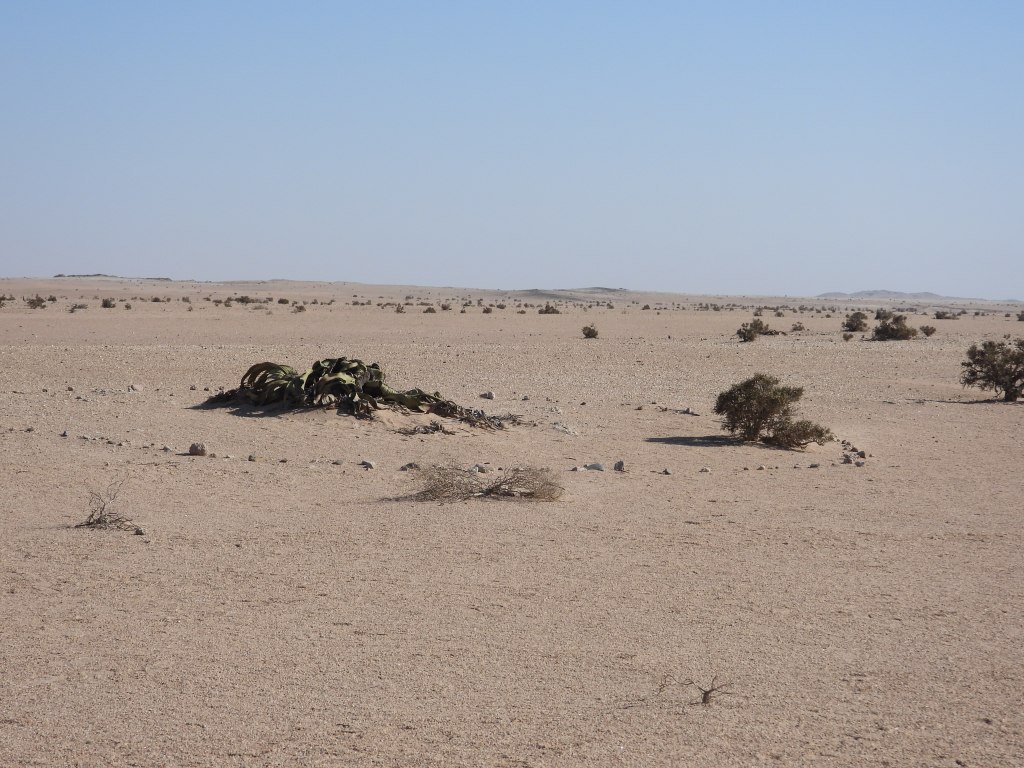
The plants that the Welwitschia plains are named after are utterly bizarre. When their namesake, Botanist Friederich Welwitsch, first came across one in Angola in 1859, it was said that he could do nothing but “kneel down […] and gaze at it, half in fear lest a touch should prove it a figment of the imagination.”
Why was he so awestruck by these plants? Their unusual growth habit may have been one reason. These are short plants with wide, woody trunks, and unlike almost any other plant, they produce only two leaves throughout their entire lives. These two tough, fibrous leaves will continue to grow throughout the life of the plant, but they will crack and split at some point, which can make it appear that the plant has more than two leaves. The leaves can also get very long, but they usually start to curl up at some point. Even so, the biggest specimens of Welwitschia can be up to 8 m in circumference.
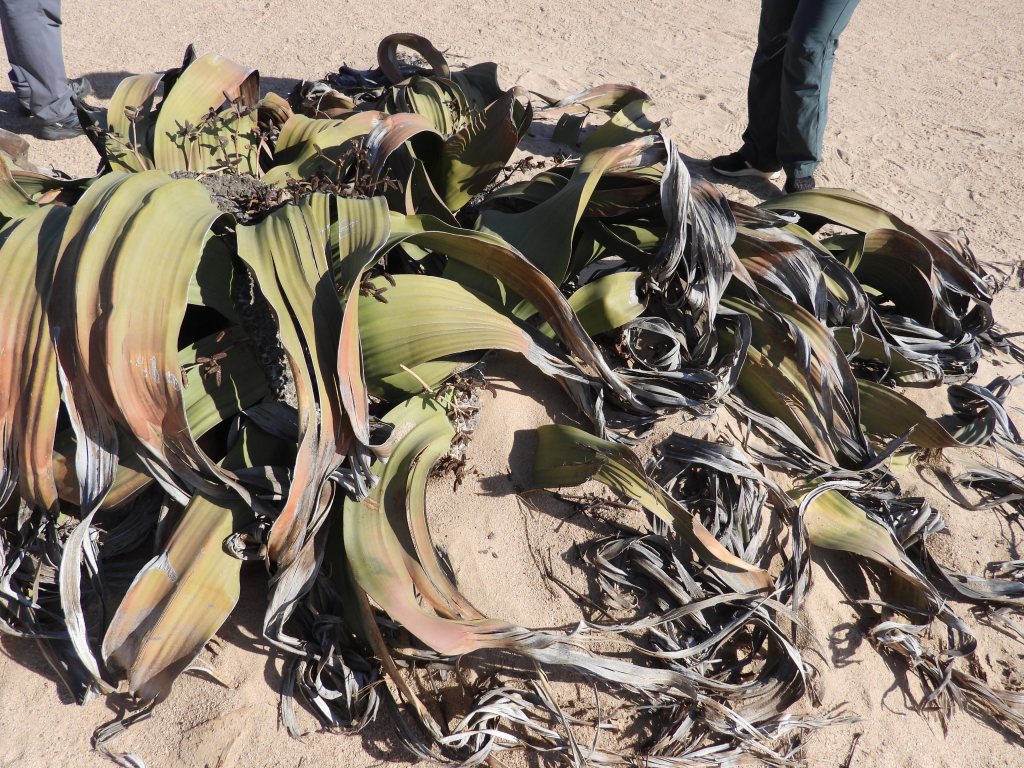
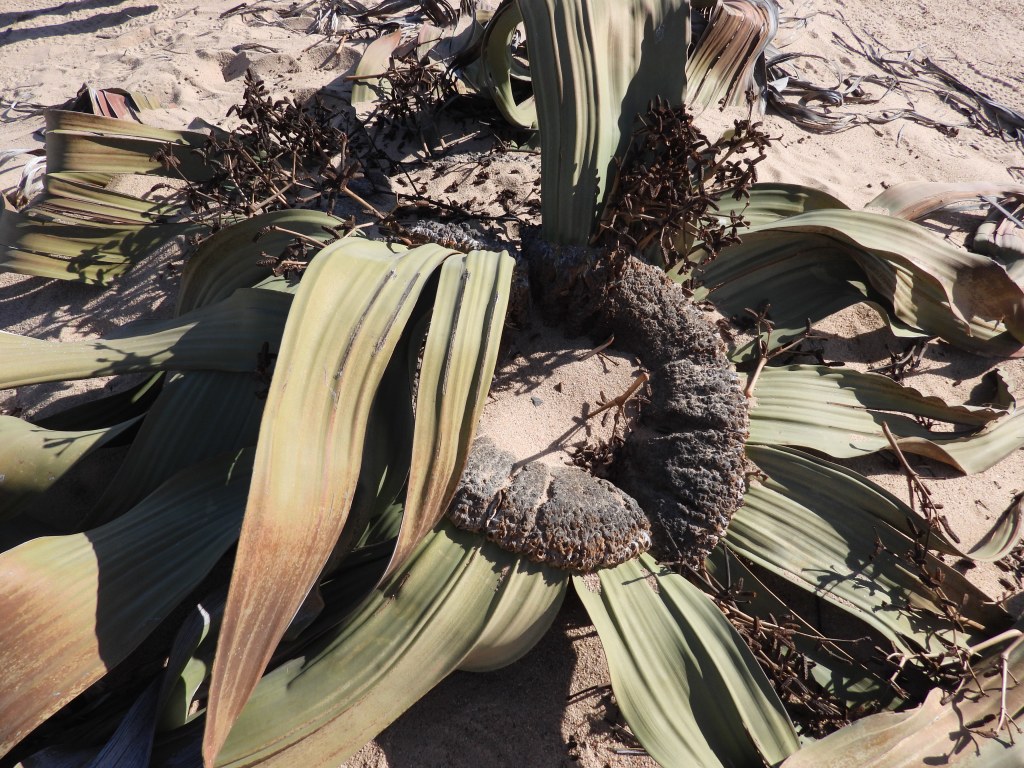
Welwitschia also lives in barren places that get very little (if any) rainfall. The loose, sandy soil they grow in also doesn’t retain water very well. Welwitschia plants manage to survive by absorbing water from fog that rolls in from the coast. They also have very long taproots that can absorb any ground water that might be present.
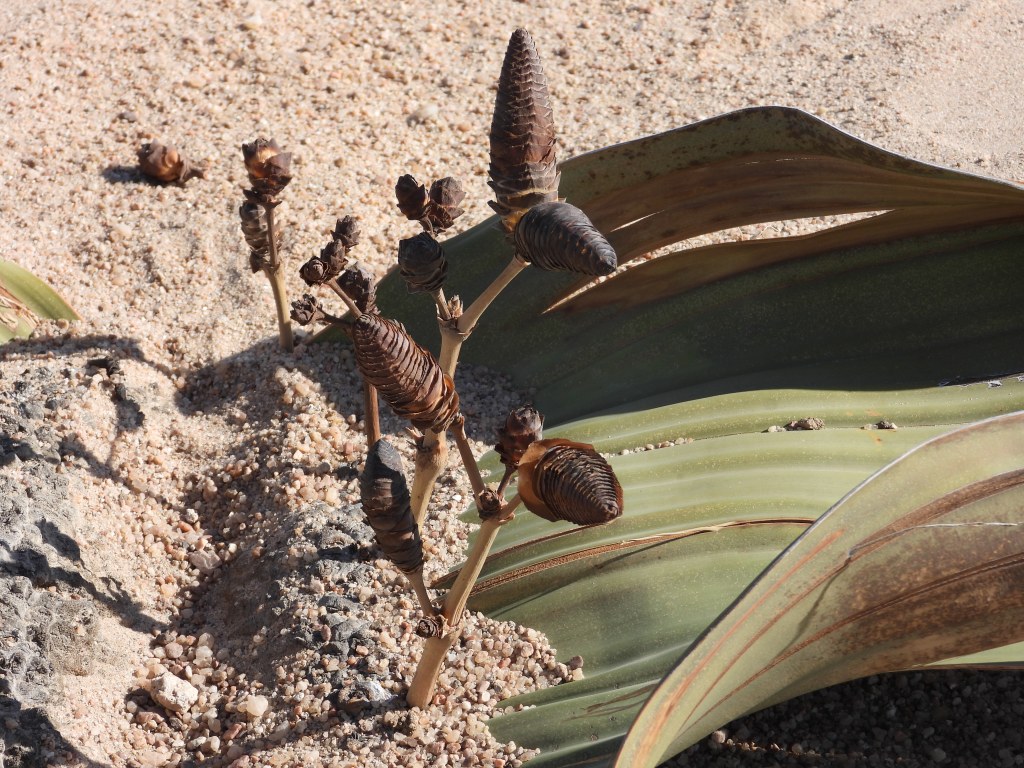
Aside from their odd morphology and ability to live in spartan environments, Welwitschia are also unusual from a taxonomic standpoint. They produce cones (not flowers), so they are classified as gymnosperms. The word “gymnosperm” means “naked seed.” Gymnosperm seeds are produced from ovules that are exposed (‘naked’) on cone scales. Gymnosperms can be contrasted with the “angiosperms” (flowering plants), whose seeds are enclosed within fruits.
The largest gymnosperm group would be the conifers (phylum Coniferophyta). There are about 600 conifer species, including the various pines, firs, cedars, junipers, spruces, and larches. The gymnosperms also include the cycads (phylum Cycadophyta), a largely tropical and subtropical group of slow-growing plants with soft wood and fern-like leaves. The maidenhair tree, Ginkgo biloba (phylum Ginkgophyta), is also a gymnosperm.

Welwitschia is unusual in that it is a gymnosperm, but it is not a conifer or a cycad, and it doesn’t resemble Ginkgo. It has been placed in a phylum of plants called the Gnetophyta. Gnetophyta is a small but motley group of plants. It includes Welwitschia, Ephedra and Gnetum. Ephedra is a genus of shrubs that are well-adapted to arid and semi-arid environments. They don’t look anything like Welwitschia, though. They have thin, branching stems and small, scale-like leaves. Gnetum is a genus of tropical shrubs, trees, or lianas (woody shrubs). Their leaves are broad and resemble the leaves of typical angiosperm trees.
The members of Gnetophyta seem like a disparate bunch, but phylogenetic studies indicate that they are more closely related to each other than they are to any other living plants. These same studies also indicate that Gnetophyta are also only very distantly related to any other living plant group.

Welwitschia are sometimes called “living fossils,” although I’m not sure if that is a truly accurate descriptor. We do know from fossil discoveries made in northeastern Brazil that the family Welwitschiaceae has been around since at least the lower Cretaceous (about 114 millions years ago). Compared with other seed plants, however, that is not terribly old. Cycads, for instance, have existed for about 300 million years, and there are fossils of plants from the phylum Ginkgophyta that are about 270 million years old.
Individual Welwitschia plants can live to great ages. Some of the largest specimens are estimated to be at least 1,500 years old. That would mean that their leaves would also be 1,500 years old. That is noteworthy because plant leaves tend to be ephemeral organs. Even the leaves of so-called evergreens do not last more than a few years. But the two leaves of Welwitschia just keep growing and growing, and they only die when the whole plant does. The Afrikaans word for Welwitschia (tweeblaarkanniedood) means “two leaves that can’t die.”

Welwitschia plants are dioecious, which means that they produce either male (pollen) or female (ovulate) cones. I managed to find individual plants of both sexes. Many gymnosperms are wind-pollinated but Welwitschia appears to be animal-pollinated because its cones produce a nectar-like substance that attracts insects.

Welwitschia is distinctive enough that it was given a place on Namibia’s coat of arms (see image below). It’s right underneath another creature that thrives in deserts – the oryx. The bird on top is an African Fish Eagle. Fish eagles are common around lakes and rivers, so I saw a lot of them in northern Namibia along the Kavango river.

It was wonderful to be able to see these plants in their natural habitats. I often talk about them in my biology classes, and now I have some pictures of them to share with the students.
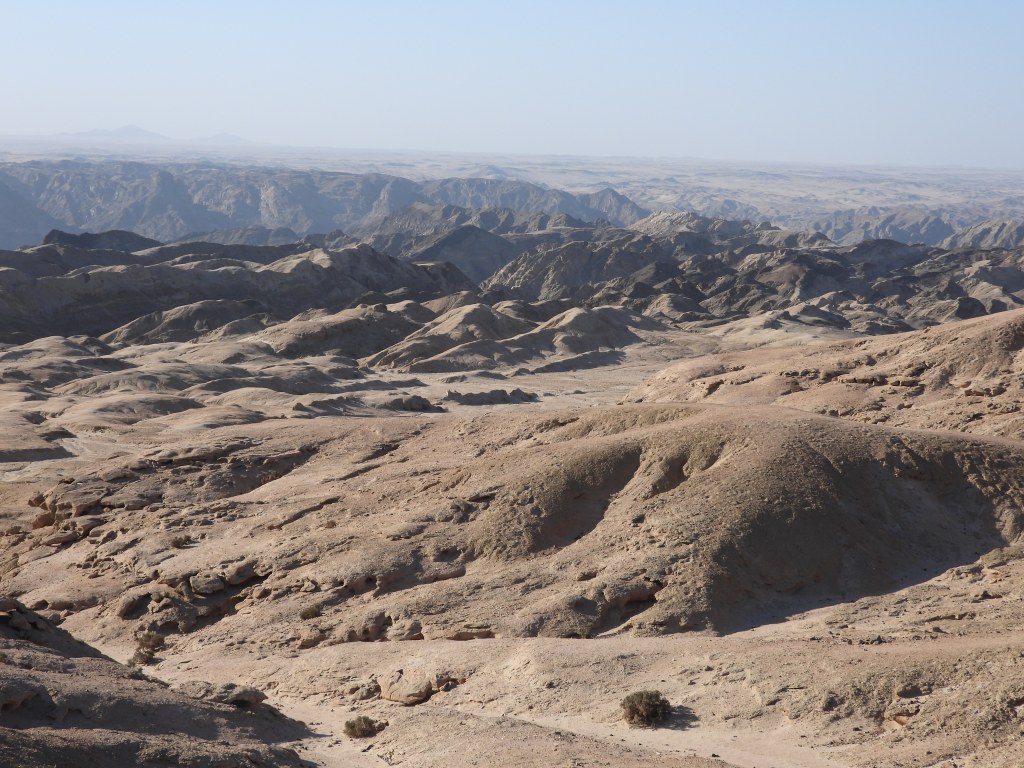
On another note, there’s also a neat hilly area near the Welwitschia plains that looks like it belongs on the moon.
My next post will feature Spitzkoppe, a mountainous region that is popular with campers.
References
Dilcher, D. L., Bernardes-De-Oliveira, M. E., Pons, D., and Lott, T. A. 2005. Welwitschiaceae from the lower Cretaceous of northeastern Brazil. American Journal of Botany 92: 1294-1310.
Hooker, J. D. 1863. On Welwitschia, a new genus of Gnetaceae. Transactions of the Linnean Society of London. 24 (1): 1–48.
 Peace Country Naturalist